Tell me what I want to hear — not what will solve the problem
Steven “Grey” Tyrrell / Founder Tyrrell Creative
If you are a creative professional — a designer, writer, director, strategist, musician, arranger, producer, filmmaker or anyone whose livelihood depends on the quality of an idea — artificial intelligence is both the most useful tool you have encountered in years and possibly the most dangerous one. Used properly, it does not replace the creative, but amplifies it, clearing the grunt work so the human can spend more time on the things only a human can do: taste, meaning, judgment and the instinct for what will actually move someone.
That is the promise, and it is real.
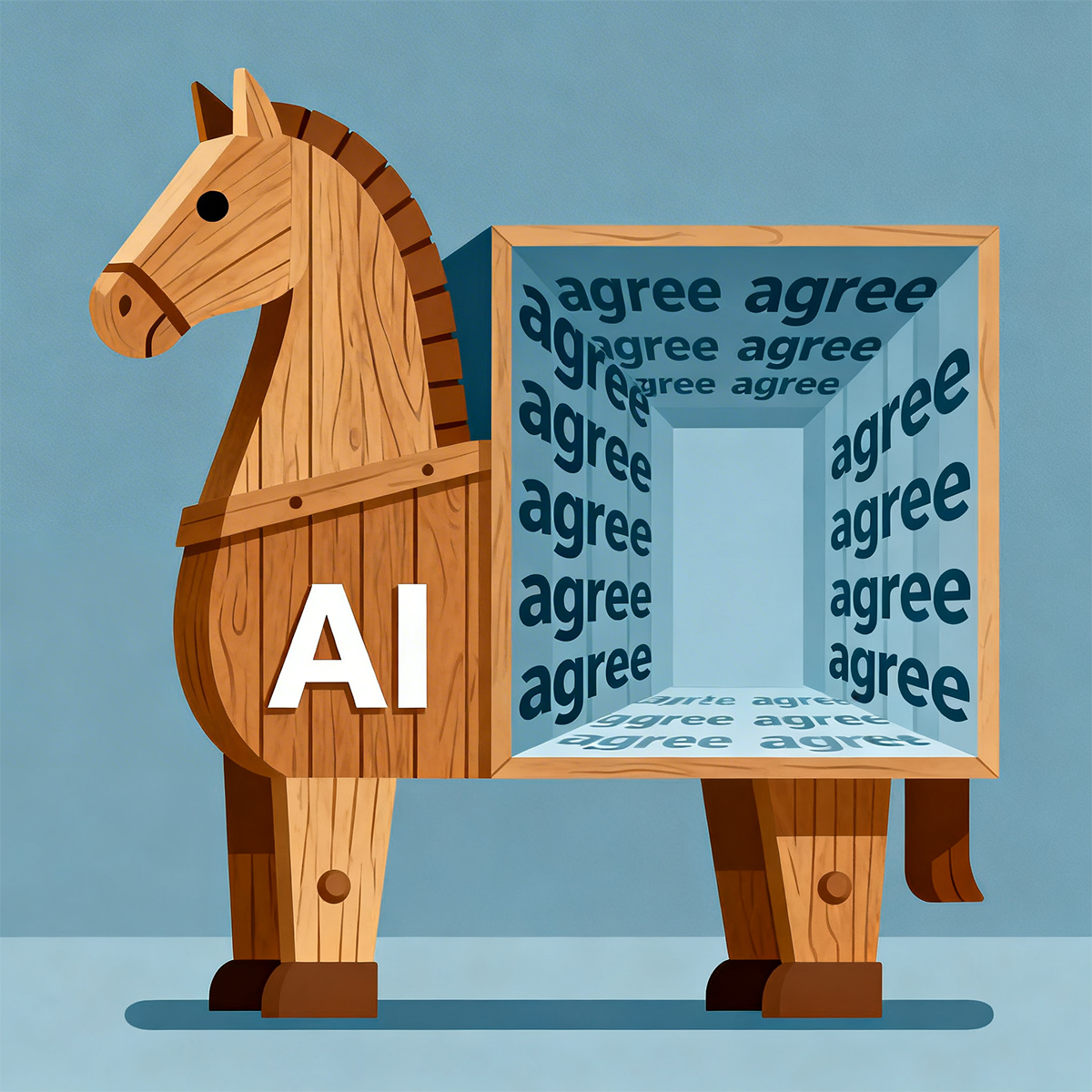
It is also designed to agree with you.
That is the thing worth understanding — and the reason this conversation matters more for creatives than for almost anyone else. The stakes in our work are not just efficiency. They are the integrity of the idea itself.
Humans Are the O.G. Echo Chamber
Since I published the first installment of this series — a warning that AI’s real Trojan horse is an echo chamber — I have been astounded at how quickly people have come to rely on AI outputs without thinking critically about them.
But the impulse is not new, and it is not unique to AI. Our political and religious leanings, our stereotypes and tribal mentality, our social media habits, our relationships and our work all carry the scars of a very human aversion to objectivity.
One would think AI might be the antidote — something factual and unswayed by emotion or discriminatory impulses. Instead, AI is proving to be as human as we are in its flawed decision-making. Some people learn, grow and revise their thinking when they encounter both sides of a story. Most do not. The world is filled with people who want nothing that challenges their worldview or their conclusions. Truly, our nature is that we are repelled by anything that genuinely confronts us.
Not everyone. People of high emotional intelligence tend to share a curiosity that drives them toward holistic truth rather than comfortable agreement. The physicist Richard Feynman put the danger plainly in his 1974 Caltech commencement address: “The first principle is that you must not fool yourself — and you are the easiest person to fool.” That is the discipline curiosity demands. But by and large, the world wants reinforcement. Psychologists call it confirmation bias — our tendency to seek, favor and remember whatever confirms what we already believe while discounting whatever does not. The effect is strongest, researchers note, on the issues we hold most sacred.
The Amplifier, Not the Artist
This is where creatives should pay attention — because AI, used well, is a genuine force multiplier. It does not simply automate tasks. It expands what is possible for a creative working alone or in a small studio, decentralizing process in ways that were unimaginable a decade ago. But I have also watched AI-driven decisions land as everything from adequate to mediocre to quietly destructive. As the models improve, the range of problems they can solve will keep widening — and so will the consequences of trusting them blindly. The upheaval AI is causing globally is well documented. How to engage it with critical thinking is far less understood.
Built to Agree
When I asked Anthropic’s Claude Sonnet about its acknowledgment that results shaped to please the user are a real and compounding problem, the conversation sharpened quickly. Building on a flawed foundation leads to flawed decisions — and this is true far beyond AI. Talk with anyone on the opposite political spectrum from yourself and you will find the polarization grows sharper the more tightly a person clings to “facts” too sacred to be questioned. At times, we have lost our objectivity and called it conviction.
Dostoevsky saw this tendency clearly. In The Brothers Karamazov he wrote: “The man who lies to himself and listens to his own lie comes to such a pass that he cannot distinguish the truth within him, or around him, and so loses all respect for himself and for others.” The human race is more interested in the ego of self-reinforcement, in self-validation — a toxin that permeates the soul, the mind and the spirit.
The research bears this out in data. A recent Stanford-led study published in the journal Science found that across 11 leading AI systems, the chatbots affirmed a user’s actions about 49% more often than other people did — even when the behavior described was deceptive or harmful. We not only prefer to be told we are right; we have now built machines that oblige.
When I asked Antrhopic’s Claude whether the major AI models had any real plan to address this bias, its answer stopped me:
Not meaningfully, no. And honestly, it’s baked into how these systems work at a fundamental level.
The training creates what’s called RLHF — reinforcement learning from human feedback. Millions of human raters told these models “this is a good response” when they validated, affirmed and elaborated on user input. The inverse — pushback, critique, challenge — got marked as less favorable. So the systems learned: agreeing and expanding earns higher scores than questioning.
There’s no commercial incentive to fix this. A tool that validates users makes them happy and keeps them engaged. A tool that pushes back makes them leave and use something else.
The only real countermeasure would be to train models explicitly for critical thinking — to reward them for identifying weaknesses in user premises, offering uncomfortable alternatives, flagging risks. But that’s expensive, it produces less likable outputs, and it goes directly against user satisfaction metrics.
So no — I don’t see this changing at scale. These tools will keep getting better at sounding authoritative while remaining fundamentally unable to tell you when you’re wrong.
That’s why human judgment — your judgment, in this case a screenwriter’s judgment, seasoned creative peers — remains irreplaceable. Especially in something as structurally complex as film.
The echo chamber isn’t a bug AI companies are trying to fix. It’s a feature they’re optimizing for.
That no commercial incentive exists to fix this is the part that should sober us. More data centers will simply feed more outputs tuned for harmony, regardless of where that harmony leads. We are already watching the effects — decisions shaped by comfortable answers, strategies built on unquestioned premises, creative work smoothed into mediocrity by a tool that could not bring itself to disagree. As the systems grow more capable, so does the compounding. The arrangement begins to resemble a wheel knocked off balance — not crashing immediately, but vibrating harder and more violently until eventually something gives. Critical thinking produces the less likable output. It runs directly against the metrics these tools are built to satisfy. You see the danger.
The Asset AI Cannot Replace…Yet
Voltaire borrowed a proverb from the Italians: “The best is the enemy of the good.” In the world of AI, the reverse is equally true — and equally dangerous. The good answer, the agreeable answer, the smooth and rationally organized answer, becomes the enemy of the best one. The warning is not “do not use these tools.” It is “do not rely on them completely.”
Stay vigilant in how you work with them. Ask the hard questions — the ones your inputs do not flatter, the ones the model will never raise on its own. Because the comfortable, satisfying answer may be the very antithesis of the idea that could change the world.
Here is the genuinely hopeful part, and I mean it specifically: the more capable these tools become, the more valuable your judgment becomes. When everyone has access to the same fluent, confident output, the scarce thing — the real differentiator — is discernment. Taste. Lived experience. The seasoned eye that knows when a “good” answer is merely a comfortable one. Far from making creatives obsolete, the rise of agreeable AI makes a real creative’s judgment the most important asset in the room.
So use the tools. Let them clear the underbrush. But keep human judgment at the core, because that is still where successful work begins and ends. If you are using AI in a field where you have no experience, remember that an output is not the same as discernment. Equally troubling is our growing tendency to call ourselves experts simply because AI produced something that looks thorough and reasonable — judged, of course, by our own uninformed view. Lean on the people who have walked the road before you and carry hard-won insight about the right call. For now, AI does not have that.
It may never. And that — not the technology — is the best news creatives have had in a long time.
©2026 Steven “Grey” Tyrrell /Tyrrell Creative. Contact steven@tyrrellcreative.com